
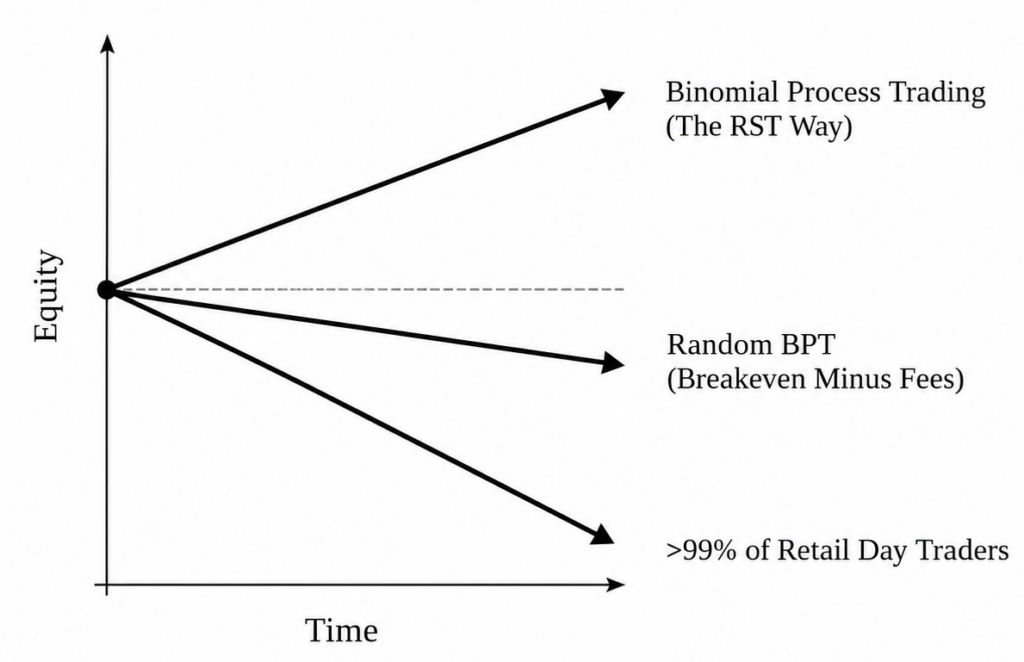
Binomial process trading transforms day trading into a predictable process that breaks even (minus fees) when trading completely at random (in other words, asking a cat to pick long or short on any stock at any time breaks even over time). With these controls in place, trader then only needs to nudge the win rate up a few points to cover fees and be profitable. This is a dramatic shift from the norm where more than 99% of day traders swiftly go bankrupt due to uncontrolled share sizing, win/loss amounts, and risk/reward ratio. Under BPT, this is all locked down so trading behaves no differently than flipping a coin or rolling a die (binomial process / two outcomes / win or lose $X / no lose $1, win $5, lose $1000…).
Summary
Binomial process trading is a risk-control framework for day trading in which each trade is structured to have a predefined loss amount, predefined profit target, and consistent risk/reward relationship. The purpose of the framework is to reduce uncontrolled position sizing and open-ended losses by converting a sequence of trades into a series of bounded win/loss outcomes. The principal value of the method is not that it predicts market direction, but that it controls risk so tightly that trading blindly at random results in breakeven, similar to flipping a coin, rolling a die, or other binomial processes where a win is a win and a loss is a loss.
This paper describes the technical basis for the framework, the assumptions needed for the binomial approximation to be valid, the limitations of the method, and the practical controls required to keep actual trading behavior aligned with the model.
1. Background
Day trading outcomes are often dominated by risk-management errors rather than by a single failure to predict market direction. A trader may enter with a reasonable setup but still produce poor long-term results if position size, stop loss, profit target, and exit discipline vary from trade to trade without control. In that condition, the trade sequence is difficult to analyze because both the probability of winning and the magnitude of wins and losses are changing at the same time.
Binomial process trading attempts to remove part of that ambiguity. It treats the outcome of each trade as one of two bounded states: a win or a loss. The trader still has to choose entries and manage execution, but the risk architecture is fixed before entry. That structure allows the trader to evaluate expected results using win rate, risk/reward ratio, number of trades, fees, slippage, and rule adherence.
2. Definition
For purposes of this paper, binomial process trading means a trading process in which each trade is constrained to a fixed or narrowly controlled loss amount and a fixed or narrowly controlled profit target. The trade is therefore modeled as a binary event: either the loss threshold is reached or the profit target is reached. The framework is analogous to a Bernoulli trial only if the exit rules are followed and if actual fills remain close enough to the planned values that the win/loss amounts remain bounded.
The method does not require the risk/reward ratio to be 1:1. A 1:1 structure is the simplest case because the break-even win rate, before costs, is 50%. Other risk/reward structures can be modeled using the same expected-value equation, but the break-even win rate changes with the payoff ratio.
3. Assumptions Required for the Model
The binomial approximation is useful only if the planned trade structure is preserved in execution. The model assumes that the stop and target are defined before entry, actual fills remain close to the planned values, the trader does not allow losses to expand beyond the planned risk, and costs are included in the expected-value calculation. It also assumes that trades being compared are similar enough that the results can be evaluated as a controlled sequence rather than as unrelated discretionary decisions.
The framework does not require individual trades to be statistically independent in the strict academic sense. However, correlation and regime exposure matter. A sequence of trades using the same setup in the same market condition may produce clustered wins or clustered losses, which can make short-term results look better or worse than the underlying process. This is one reason the framework should be evaluated with trade logs, realized versus planned risk, drawdown, and enough observations to make the sample meaningful.
4. Expected-Value Model
Let p be the probability of a winning trade, W be the average gross win amount, L be the average gross loss amount, and C be the average total cost per trade, including commissions, fees, spread, and slippage. The expected value per trade can be written as:
EV = pW − (1 − p)L − C
For a 1:1 structure where W = L, the gross break-even point is p = 0.50. After costs, the required win rate is higher than 50%. This distinction matters. A trader can have a structurally controlled process and still lose money if trading costs, poor fills, or execution errors move the realized result below the modeled result.
The main technical advantage of the framework is that it separates two questions that are often mixed together: whether the trader has a predictive edge, and whether the trader is controlling the size of losses. The framework cannot create a market edge by itself. It can, however, prevent a small predictive edge from being overwhelmed by uncontrolled downside.
5. Control Requirements
The framework depends on controls that are implemented before the trade is placed. The minimum controls are:
- predefined risk/reward ratio;
- predefined exit price for loss / hard stop based on candlestick setup;
- predefined exit price for win based on hard stop price and chosen risk/reward ratio; and
- share sized strictly based on desired win/loss amounts and predefined exit prices.
Without these controls, the process stops being binomial in any useful sense. A trade that is allowed to run past the planned stop, averaged down without a defined rule, or closed early for discretionary reasons may still be a trade, but it is no longer part of the controlled sequence being modeled.
6. Relationship to Trader Profitability
A controlled binomial process can be useful because the profitability threshold becomes explicit. If the payoff ratio and cost structure are known, the trader can calculate the win rate needed to break even and the win rate needed to produce a target return. This is more useful than reviewing profit and loss alone because it identifies whether performance is coming from edge, position-size drift, unusual outliers, or uncontrolled risk.
The framework also provides a practical diagnostic. If a trader’s realized losses are larger than planned losses, the issue is not market prediction; it is process control. If realized wins and losses match the planned values but the win rate is too low, the issue is trade selection or market edge. If the gross result is positive but the net result is negative, costs and execution quality are the limiting factors.
7. Limits and Failure Modes
Binomial process trading is not a complete trading system. It does not identify entries, determine whether a market is favorable, or remove the need for skill. It is a risk-control and measurement framework. The most important limitations are:
- Execution risk. Stop and target orders may fill at different prices than expected, especially in fast markets.
- Cost drag. Commissions, fees, spread, and slippage move the break-even win rate above the gross theoretical value.
- Behavioral drift. Moving stops, changing targets, averaging down, or skipping rules can invalidate the model.
- Correlation and regime risk. A sequence of trades may not be independent if the same setup is repeatedly exposed to the same market condition.
- Tail events. Gaps, halts, platform failures, and liquidity failures can produce realized losses larger than planned losses.
These limitations do not make the framework unusable, but they define the boundary conditions. The model is most useful when the trader can keep realized losses close to planned losses and when the number of trades is large enough for aggregate performance to be meaningful.
8. Practical Implementation
A practical implementation begins with fixed dollar risk per trade based on how much the trader wishes to risk per trade. For example, 1% of a $50,000 account would be $500. The trader then determines the stop distance for the specific setup and calculates share size from the allowed risk. The profit target is selected using the intended risk/reward ratio. The stop and target are placed as part of the initial trade plan rather than added after the trade has already moved.
For example, if the planned loss per trade is $500 and the stop distance is $0.25 per share, the position size is 2,000 shares before considering fees and platform constraints. In a 1:1 structure, the gross target would also be $500. The specific numbers are not important; the important feature is that the loss amount is calculated before entry and is not allowed to expand because the trader becomes uncomfortable with the result.
9. Assessment
Binomial process trading is best understood as a disciplined risk-control framework rather than as a claim of predictive superiority. Its usefulness depends on whether the trader can consistently enforce bounded outcomes and then improve trade selection enough to overcome costs. This is most effectively done in trading platforms that support automated share sizing based on risk such as DAS Trader. When enforcing binomial process trading in a platform such as DAS Trader, the methodology described herein effectively becomes “one button trading” since DAS Trader can automatically send exit orders when the desired exit prices are reached (range orders). So once a trader activates the hotkey to open the trade, the rest is automated, which also removes the psychology of trading aspect (another advantage of binomial process trading).
The principal risk is overstatement. A bounded win/loss framework can make day trading more measurable, but it does not eliminate market risk, behavioral risk, execution risk, or the empirical difficulty of day-trader profitability. The appropriate claim is narrower and stronger: binomial process trading provides a method for making trade-level risk explicit and for testing whether a trader’s actual results are consistent with the planned process. It gives the trader a fighting chance by starting at breakeven with completely random trading. Nudging the win rate a few points higher will cover commissions and fees and generate profits; the risk of going bankrupt despite high win rate – which is prevalent in other systems – is significantly reduced with binomial process trading.
References, Related RST Pages, and Disclaimer
- What Is Binomial Process Trading?
- Chapter 7: Risks
- Chapter 8: The RST Way
- Chapter 9: Trader Profitability
- Barber, Brad M., et al. “The cross-section of speculator skill: Evidence from day trading.” Journal of Financial Markets 18 (2014): 1–24.
This paper is for educational purposes only and is not investment advice, trading advice, or a recommendation to buy or sell any security. Trading involves substantial risk, and a risk-control framework does not eliminate market, execution, behavioral, liquidity, or account-level risk.