
Summary
The binomial distribution is useful for day traders because it explains how a trading system with a fixed win amount, fixed loss amount, and known win rate can still produce noisy short-term results. A trader can have a positive edge and still experience disappointing blocks of trades. The point is not to eliminate variation. The point is to understand it well enough that normal statistical noise is not mistaken for a broken system.
This matters for binomial process trading because BPT is built around controlled win/loss outcomes. When a trade is structured as a defined win or a defined loss, the trader can evaluate performance using win rate, risk/reward ratio, expected value, sample size, drawdown, and trade-block results. Without that control, the math becomes much less useful because every trade has a different size, a different exit behavior, and a different downside profile.
Why the Binomial Distribution Matters
A binomial process has two possible outcomes for each trial. In trading terms, the simplified structure is:
- the trade reaches its planned win outcome; or
- the trade reaches its planned loss outcome.
That is the reason fixed risk and fixed reward are so important. If the trader changes share size, moves stops, exits early without a rule, adds unpredictably to losing positions, or lets one loss become much larger than planned, the trade sequence no longer behaves like a clean series of comparable trials. The trader may still be trading, but the results are no longer easy to diagnose.
In a controlled process, however, the trader can ask better questions: What win rate am I actually producing? How much variation should I expect over 50 or 100 trades? Is this drawdown normal for the system, or evidence that something changed? Those questions are central to The RST Way.
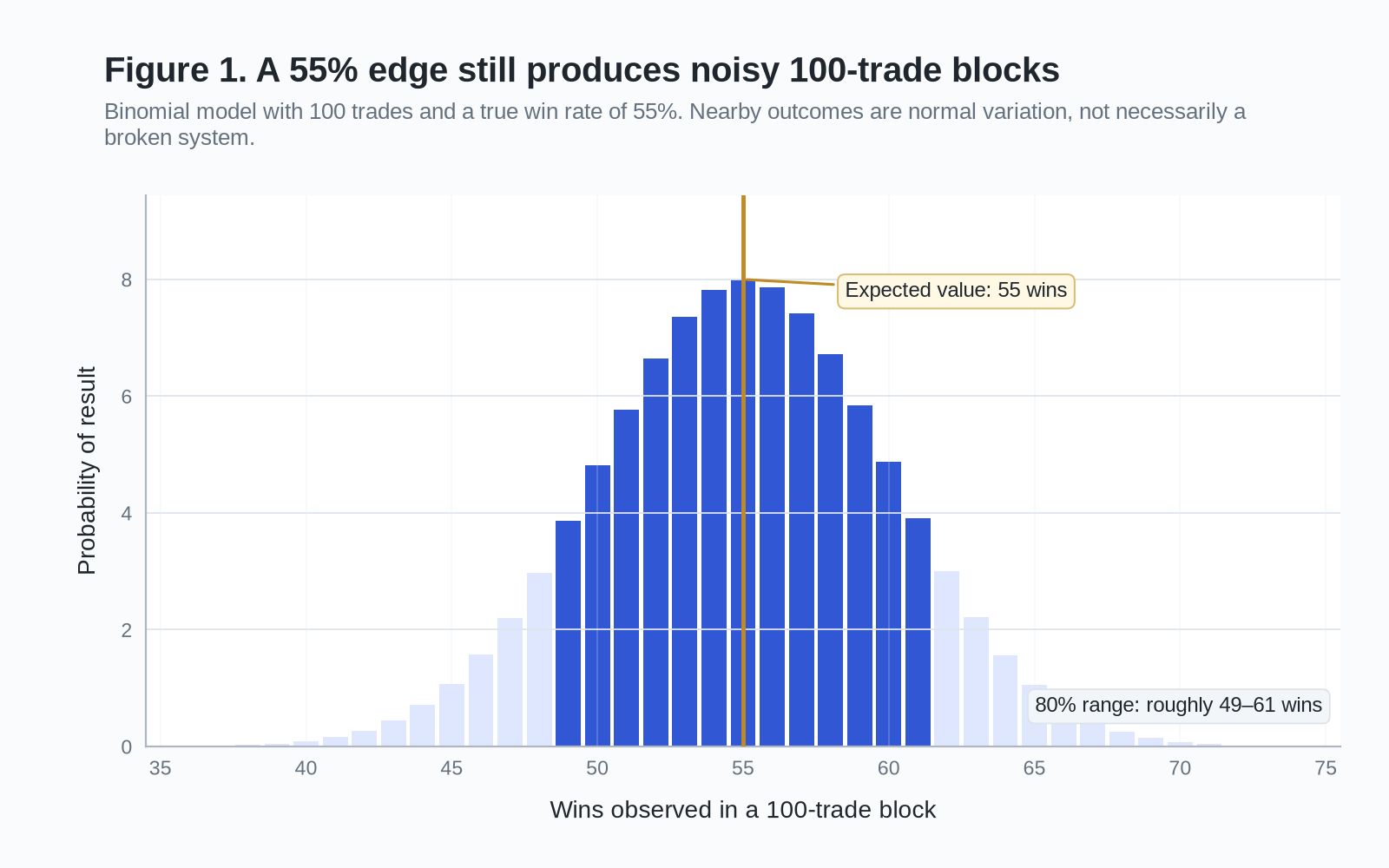
Figure 1 shows why one block of trades should not be overinterpreted. With a true 55% win rate over 100 trades, the most likely result is near 55 wins. But results in the high 40s or low 60s can still happen without any change in the underlying process. That is not a failure of the method. It is the math doing what the math does, usually with poor bedside manner.
Expected Value and the Profitability Threshold
The BPT technical white paper gives the expected-value model more formally. In plain English, a trader becomes profitable when the average win rate and risk/reward ratio overcome the average cost of trading.
For a simple 1:1 risk/reward structure before costs, 50% is the gross break-even point. Win half the trades, lose half the trades, and the planned wins and losses cancel out. After commissions, slippage, spread, and fees, the practical break-even win rate is higher than 50%. That is why small win-rate differences matter so much.
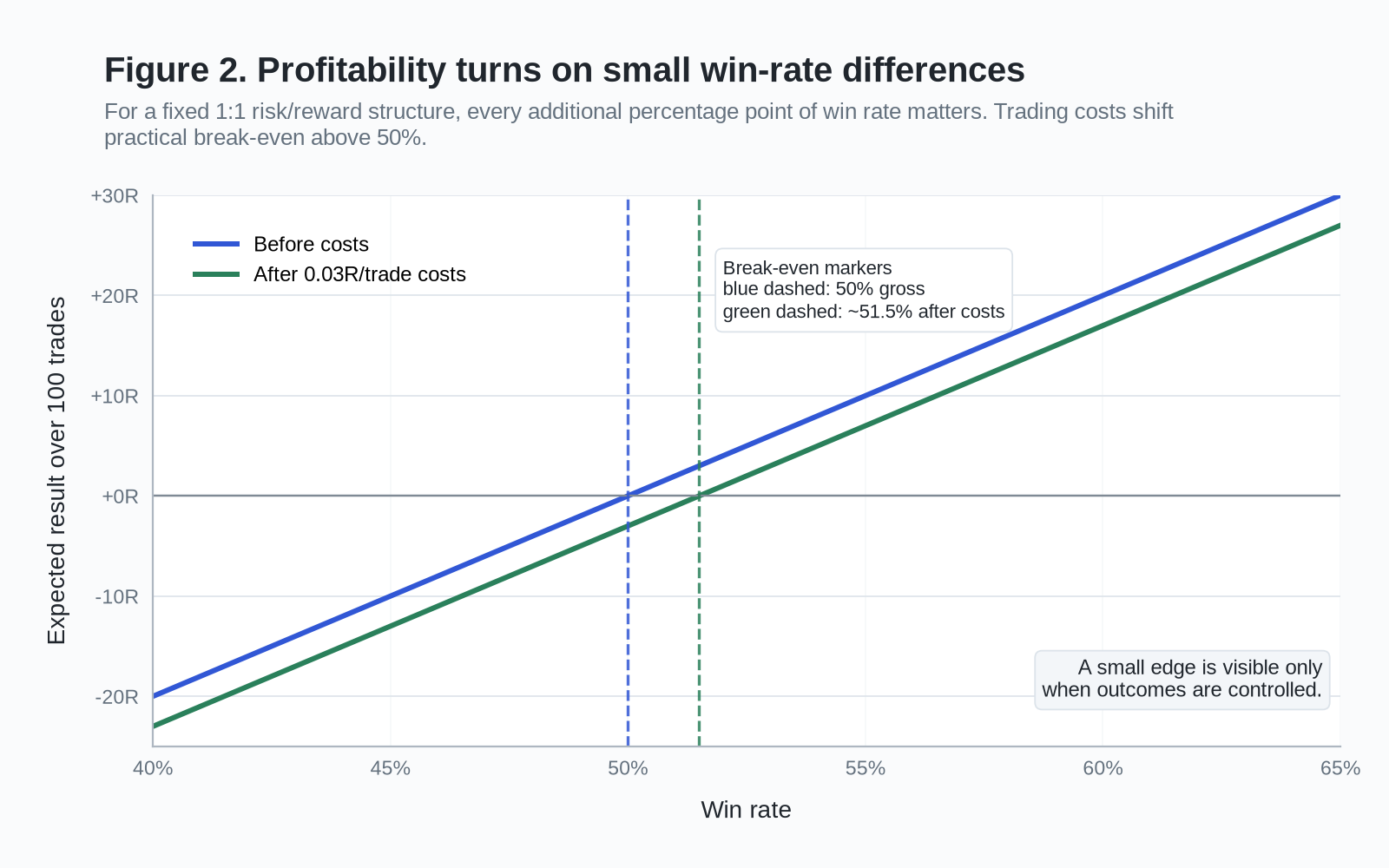
Figure 2 shows the basic profitability threshold. A small edge is not glamorous, but it can be powerful if the process is consistent. The key requirement is that the trader must preserve the structure long enough to measure whether the edge exists. Constantly changing the process after every few trades makes the result impossible to interpret.
Why Small Samples Mislead Traders
One of the most dangerous mistakes in day trading is overreacting to small samples. A trader may take 20 trades, lose more than expected, and decide the system is broken. Or the trader may win more than expected and assume the system is better than it really is. Both reactions are common. Both are dangerous.
The binomial distribution helps explain why The RST Way emphasizes trade blocks. A 20-trade sample can say very little. A 50-trade sample is better, but still noisy. A 100-trade block starts to become more useful. Larger samples are not perfect, but they make it easier to separate bad luck from bad trading.
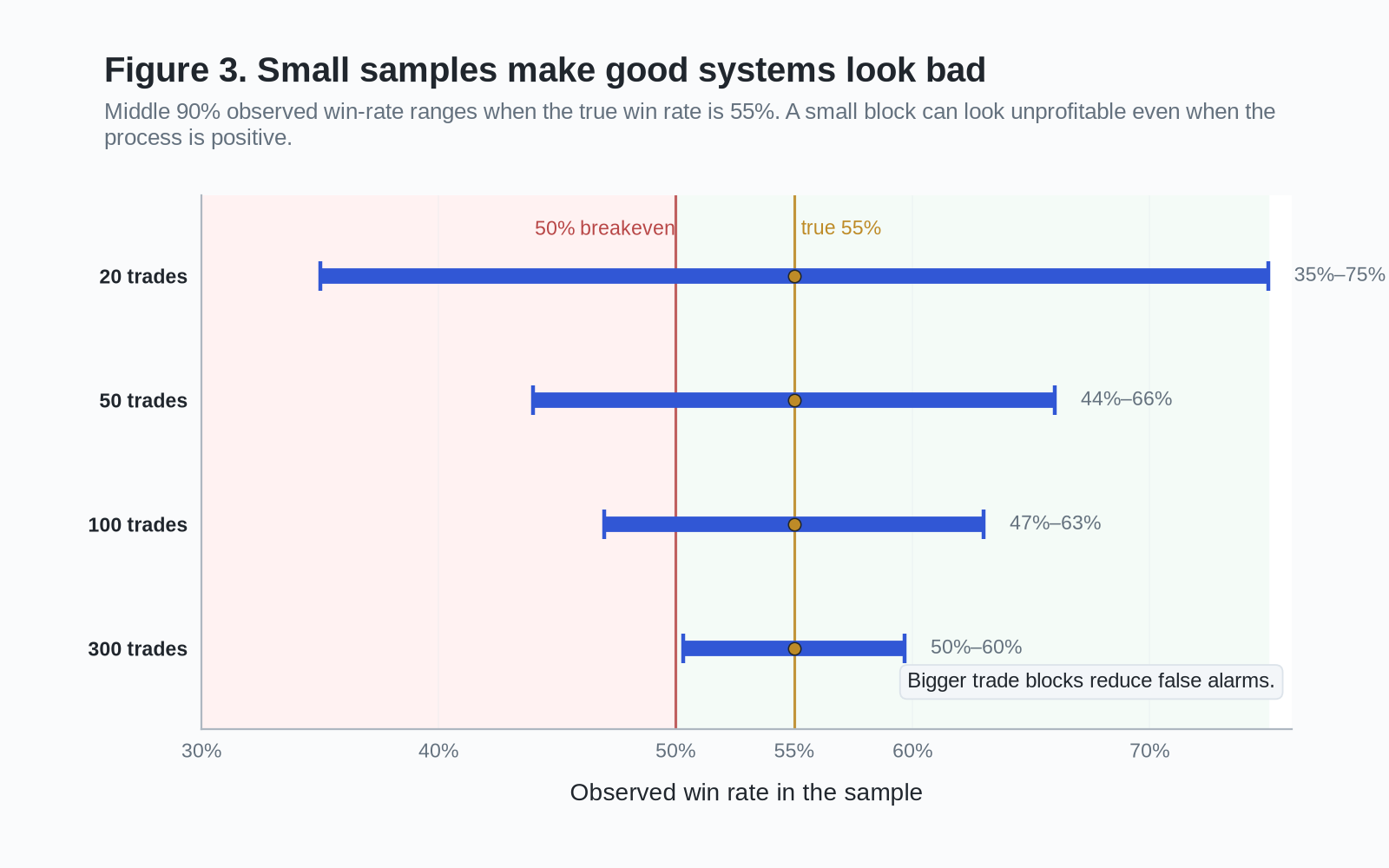
Figure 3 shows the problem. If the true win rate is 55%, a small sample can still produce an observed win rate below break-even. That does not automatically mean the trader has no edge. It may simply mean the sample is too small. This is why changing the playbook after every bad day is a good way to destroy a system before it has had a chance to prove itself.
Connection to Gambler’s Ruin
The binomial distribution also connects to Gambler’s Ruin and day trading risk. Even a trader with a real edge can experience losing streaks. If the trader risks too much per trade, the account may not survive long enough for the edge to show up. A profitable system is not useful if the trader is forced out by position sizing, uncontrolled losses, or normal statistical variation.
This is where fixed risk and predefined exits matter. They do not make losses pleasant. They do make losses bounded, measurable, and survivable. The goal is not to avoid every losing streak. The goal is to size risk so that the trader can keep operating through normal losing streaks and still have enough capital to benefit from the long-term edge.
What This Means for Trader Profitability
Trader profitability is not determined by one trade, one day, or one emotional reaction to a losing streak. It is determined by the relationship among:
- win rate;
- risk/reward ratio;
- cost per trade;
- risk size;
- sample size; and
- discipline in following the planned process.
The purpose of BPT is to make those variables visible. When each trade has a controlled win amount and controlled loss amount, the trader can measure performance like a process rather than narrating each trade like a personal tragedy. This is the same basic idea discussed in Chapter 9: Trader Profitability, but focused specifically on how the binomial distribution explains the variation.
What the Binomial Distribution Does Not Prove
The binomial distribution does not prove that a trader has an edge. It does not identify good entries. It does not remove trading costs. It does not guarantee that the future will match the past. It also assumes the trade outcomes are clean enough to be modeled as repeated win/loss trials, which is only reasonable when the trader actually follows the planned risk process.
That limitation is important. The model is useful because it gives the trader a way to evaluate performance, not because it magically turns day trading into coin flipping with better branding. The human still needs skill, discipline, risk control, and enough trades to make the data meaningful.
Practical Assessment
The practical takeaway is simple: do not judge a trading process from a tiny sample, and do not let uncontrolled risk destroy the sample before it becomes meaningful. If the trader follows a fixed-outcome process, the binomial distribution can help estimate expected variation, interpret losing streaks, and decide whether performance changes are real or just statistical noise.
For day traders using The RST Way, that means trading in meaningful blocks, recording planned versus actual risk, and reviewing the data before making changes. The goal is not emotional certainty after every trade. The goal is a process that can survive long enough to be measured honestly.
Related Reading
- What Is Binomial Process Trading?
- Binomial Process Trading: Technical White Paper
- Gambler’s Ruin and Day Trading Risk
- Chapter 8: The RST Way
- Chapter 9: Trader Profitability
This article is educational and does not eliminate trading risk. Day trading involves substantial risk, and traders can lose money even when following a defined process.