
Summary
Gambler’s ruin is the risk that a trader with limited capital will eventually be forced out of the game by a severe enough loss sequence. In day trading, the risk is not only that a trader has a bad entry or a weak read on the market. The larger problem is that repeated trades, inconsistent position sizing, oversized losses, and normal losing streaks can combine until the account can no longer recover.
The purpose of this article is to explain gambler’s ruin in practical day-trading terms and show why fixed risk, predefined exits, and binomial process trading controls are used in The RST Way. These controls do not eliminate market risk, but they reduce one of the most common account-failure modes: allowing individual losses and losing streaks to expand beyond the planned risk model.
What Gambler’s Ruin Means
Gambler’s ruin is a probability problem involving a player with finite capital who repeatedly takes bets against a system or opponent that can continue longer than the player can. Even if the individual bets appear reasonable, a long enough unfavorable sequence can exhaust the player’s capital before the expected average outcome has time to appear.
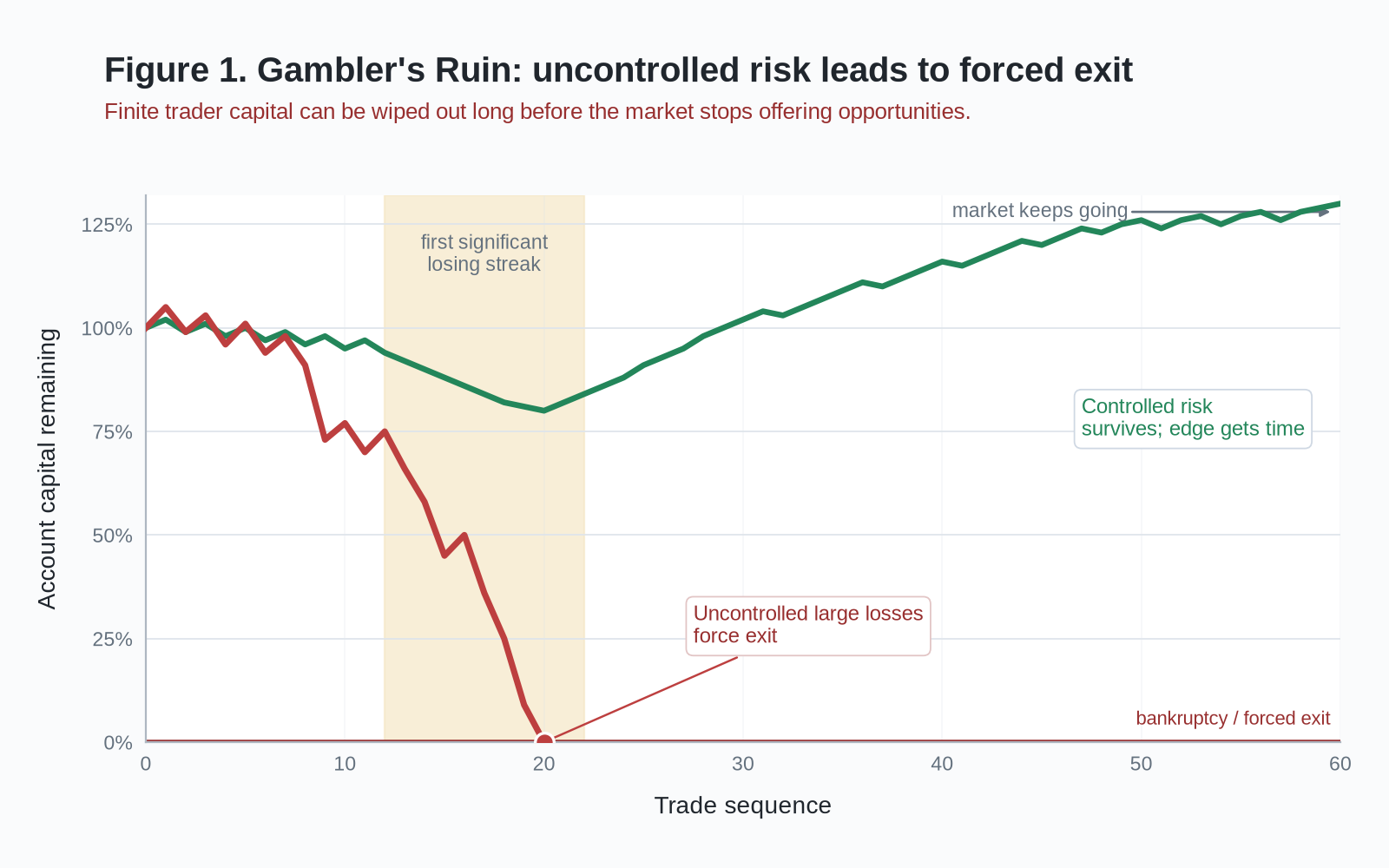
The day-trading version is straightforward. A retail trader has a finite account. The market does not. If the trader risks too much per trade, allows losses to grow, or changes position size without control, then a normal adverse sequence can become an account-ending event. The trader may be correct often enough to feel competent but still be structurally exposed to ruin.
Why It Matters in Day Trading
Day trading creates many opportunities for small errors to compound. A trader may enter a trade with a planned stop, move the stop after the trade goes against them, add to the position, or take a larger size because the setup “looks better” than usual. Each of these decisions may feel minor at the time. Across a sequence of trades, they make the risk distribution harder to measure and increase the chance that one trade or one losing streak dominates the account history.
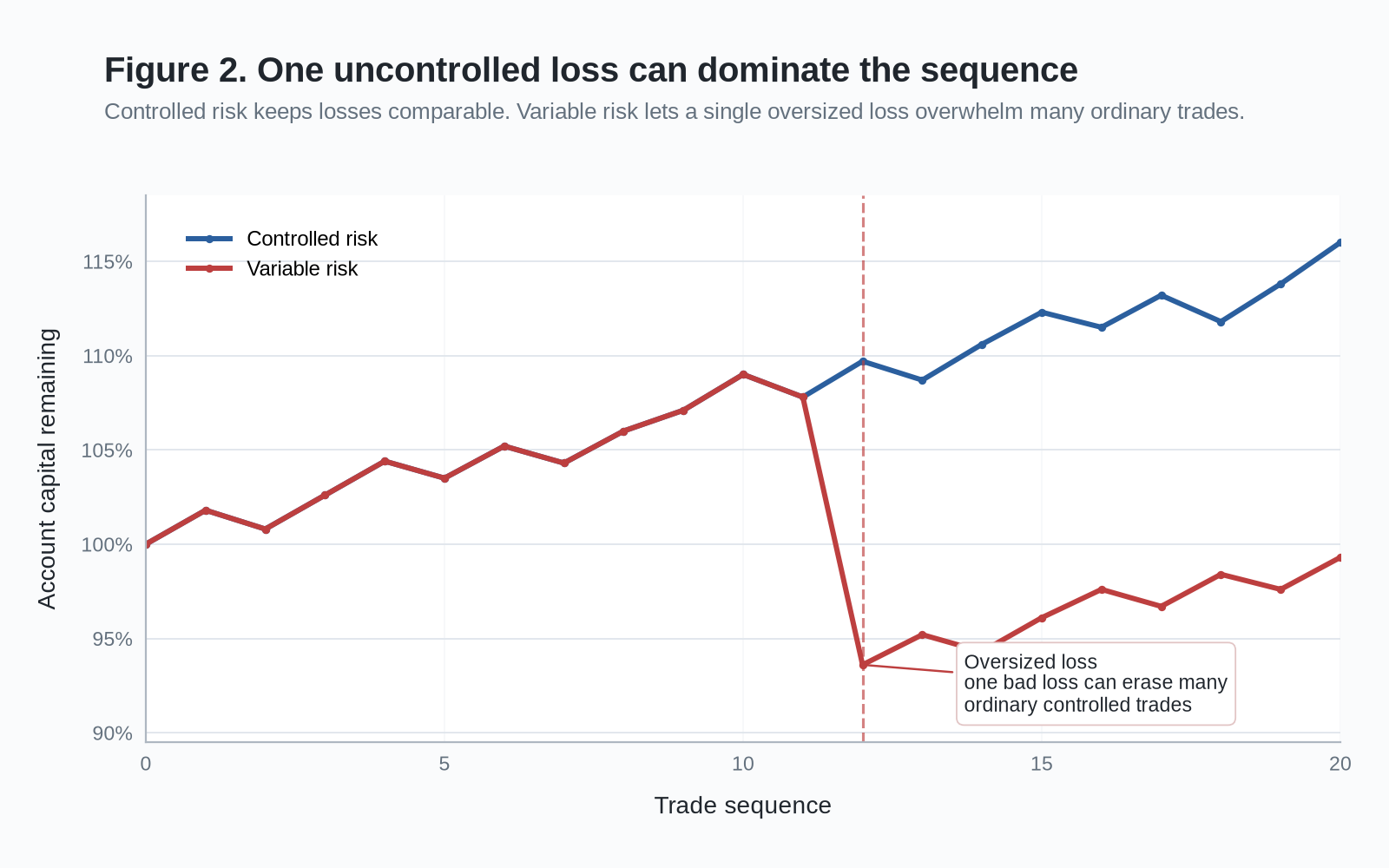
With the information currently available, the main account risk for many retail day traders is not a single incorrect prediction. It is uncontrolled downside. A trader can survive being wrong many times if the loss amount is controlled. The same trader may not survive a small number of oversized losses if the process allows risk to expand when the trader is under pressure.
Risk Size and Losing Streaks
The size of each loss determines how much room the trader has for normal variance. A trader risking 1% of the account per trade can withstand a much longer losing sequence than a trader risking 10% per trade. This does not mean 1% is always the correct number, but it illustrates the principle: lower and more consistent risk per trade gives the account more chances to continue operating.
Losing streaks should be expected even in a profitable system. If the trader treats every loss as evidence that the system is broken, the process will constantly change and the results will be difficult to evaluate. If the trader assumes a losing streak cannot occur, the account may be sized too aggressively. The correct response is to design the risk per trade so that an unfavorable sequence is survivable before the sequence occurs.
The Day-Trading Failure Mode
The most dangerous version of gambler’s ruin in day trading is not always obvious. It often appears as a series of discretionary exceptions. The trader widens one stop because the stock “should” reverse. They take extra size because they want to make back a prior loss. They exit winners early but give losers more room. They use round share sizes instead of calculating position size from the actual stop distance. These decisions break the relationship between the planned risk and the realized risk.
Once that relationship is broken, the trader may no longer know whether the trading method is failing or whether the risk process is failing. The account can decline even if the trader has some market-reading skill, because the size of the losses is no longer bounded tightly enough to let the edge show up.
Relationship to Binomial Process Trading
Binomial process trading addresses this problem by forcing each trade into a controlled win/loss structure. The trader defines the maximum planned loss, the profit target or exit condition, and the share size before entry. The result is not risk-free trading. It is measurable trading.
This matters because gambler’s ruin is driven by capital depletion. A controlled process cannot guarantee the trader will make money, but it can reduce the probability that one uncontrolled loss or one poorly sized losing streak will consume the account. The framework also makes the diagnostic cleaner: if losses are larger than planned, the risk-control process is failing; if losses are controlled but the win rate is too low, the issue is trade selection or market edge.
What These Controls Do Not Solve
Fixed risk does not make a losing trading system profitable. It also does not remove slippage, gaps, liquidity problems, platform failures, or poor trade selection. A trader can follow risk controls correctly and still lose money if the win rate, payoff ratio, and trading costs do not produce positive expected value.
The value of the controls is narrower and more useful. They keep the account from being damaged by avoidable risk expansion while the trader evaluates whether the trade playbook has an edge. This is a lower claim than saying the method predicts the market. It is also the more defensible claim.
Practical Controls
A trader trying to reduce gambler’s ruin risk should define the following before entering a trade:
- maximum dollar risk per trade;
- loss exit price or hard stop based on the setup;
- profit target or exit rule based on the selected risk/reward ratio;
- share size calculated from the allowed risk and stop distance;
- rules for reducing size or stopping trading during abnormal market conditions; and
- trade logs that compare planned risk with realized risk.
These controls do not need to be complicated. They need to be enforced. The purpose is to make each trade part of a comparable sequence rather than a collection of emotionally adjusted exceptions.
Assessment
With the information currently available, gambler’s ruin is best treated as a structural risk in day trading. It is not only a theoretical gambling problem. It describes the practical account risk created when a trader with finite capital repeatedly exposes that capital to uncontrolled downside.
The RST Way and binomial process trading are designed to reduce that structural risk by making loss size, win size, and position size explicit before entry. This does not guarantee profitability, but it gives the trader a defined process for surviving variance long enough to evaluate whether the trading method has a real edge.
Related Reading
- What Is Binomial Process Trading?
- Binomial Process Trading: Technical White Paper
- Chapter 7: Risks
- Chapter 8: The RST Way
- Chapter 9: Trader Profitability
This article is for educational purposes only and is not investment advice, trading advice, or a recommendation to buy or sell any security. Trading involves substantial risk, and risk-control methods do not eliminate market, execution, behavioral, or account-level risk.