
There are many brokerages you could use for day trading, but when you consider the unique needs of day traders, especially those trading The RST Way, there are just a few candidates to consider.
Brokerage choice affects commissions, slippage, and execution, which are the costs that a binomial process trading system must overcome after the break-even starting point.
Commission-Free Brokerages
Before discussing the right brokerages, I want to mention the wrong ones, including commission-free platforms like Robinhood and Webull, as they have become massively popular. I want to warn you against using these for day trading.
Robinhood and Webull’s rapid growth was fueled by people stuck at home during the COVID-19 pandemic of 2020. Some had lost their jobs and needed to replace income, while others just had more time on their hands, as they couldn’t travel or socialize as much. The user growth was so large that it overwhelmed Robinhood’s systems, and you can find countless horror stories online of trades gone wrong during the spring of 2020 due to service outages.
In addition to system reliability issues, Robinhood, Webull, and similar apps rely on a system called Payment for Order Flow (PFOF). PFOF is how these apps make money without charging commissions. In a PFOF arrangement, brokerages such as Robinhood and Webull act as a pass-through for their platform’s order flow, which is ultimately filled by market makers such as Citadel Securities. High-frequency trading (HFT) firms like Citadel are happy to pay for the order flow from a huge population of uninformed amateur traders. Therefore, Citadel pays Robinhood for the order flow, and Robinhood doesn’t have to charge its customers commission fees.
PFOF was created by none other than Ponzi scheme extraordinaire Bernie Madoff. PFOF itself is not illegal, but the practice makes it very easy for the parties involved to engage in illegal activities, such as front-running and other practices that do not uphold these firms’ “best execution” obligations. It’s not surprising that Robinhood was fined $1.25M in 2019, and Citadel was fined $700,000 in 2020 for these types of violations.
Despite the order flow being processed by gigantic HFT firms like Citadel, the trade execution experienced by Robinhood and Webull users is quite poor compared to that of direct-access platforms and brokers. When the market opens at 9:30 a.m., stock prices can swing 1-5% within seconds, and 10% or more within a minute. When you enter a trade, you want the exact price you see on your chart software. There’s no telling where the price could be in 10-20 seconds; you could miss the opportunity entirely. On PFOF-based mobile platforms, the price at which your order is filled can differ significantly from the price you saw when you sent the order. This poor execution – along with PFOF – is a showstopper for professional day traders. Commission-free trading apps like Robinhood and Webull are not recommended for serious day trading.
Direct Market Access Brokers
Direct market access (DMA) means that a broker and a trading platform connect a trader directly to stock exchanges and electronic communication networks (ECNs) where trades are executed. These are the types of brokers and platforms professional day traders use. There are no middlemen or shady PFOF in the way. Table 4.1 lists three DMA brokerages suitable for day trading that we’ll discuss in this chapter.

Table 4.1. Direct market access brokerages.
Account Types
DMA brokerages offer different account types, which change over time. In some cases, they offer both direct access and PFOF-based accounts, so be sure to choose a non-PFOF option.
Margin (Leverage) Accounts Versus Cash Accounts
Leverage means using someone else’s money to amplify what you could afford to trade on your own. The two most common examples of this are real estate and stock trading. Leverage is a big part of why so many people find these opportunities so attractive.
For real estate, you can get a low-interest loan to buy as much as 50 times (or more) than you could afford otherwise. Stock brokers in the U.S. provide accounts with up to 4:1 margin, and overseas brokers like CMEG offer as much as 6:1. With 4:1 margin on a $30,000 equity account, your buying power is $120,000. Buying four times as many shares means your profit will be four times as great as with no margin. This also means your losses will be four times greater.
Alternatively, you could trade on a cash account with no margin. Although it’s generally preferred to trade on a margin account to enjoy the increased buying power, a margin account generally requires higher minimum deposits and daily balances to enjoy trading on margin.
Minimum Equity (Pattern Day Trader Rule)
The Pattern Day Trader Rule required traders using margin accounts at US-based brokerages to maintain a minimum of $25,000 in their accounts. However, this was phased out due to new legislation that passed in April, 2026. See broker websites for up-to-date information on how their services will change due to this legislation. In general, it will make it easier for people using US-based brokerages to day trade without requiring high initial deposits or daily balances.
Trading Platform
The trading platform you use with these brokers may be provided by the broker itself or by a third party. For example, you may open an account at Interactive Brokers and sign up separately at DAS Trader to use their software with your Interactive Brokers account. Regardless of which broker or trading platform you use, it must provide direct access to the markets.
The most important feature of the trading platform for RST traders is support for hotkeys. Hotkeys allow you to execute complex trades, including automatic range/exit orders, with the touch of a button. There are many platforms that support scripting, hotkeys, and various other forms of automation, but DAS Trader is the only trading platform that fully supports The RST Way of trading. Plus, DAS Trader is the only trading platform that is a NASDAQ Certified Partner, and it’s a “Platinum” partner to boot.
Because DAS Trader is the best for The RST Way of trading, it is referenced frequently in the book. However, The RST Way of trading is possible in other platforms – it will just require more manual execution, which might lead to mistakes or missed opportunities, as it will slow you down. This means certain types of fast-paced trades will not be possible in those platforms, but longer time scales on less volatile stocks can be traded The RST Way. We’ll discuss that further in Chapter 8.
Broker Platform and Data Fees
The platform fee covers the trading software, and the data fee covers the specific data you want streamed into it. Brokerages have long lists of data packages you can purchase à la carte. Personally, I go with whatever the cheapest option is that provides level 2 data.
Platform and data fees can be over $200 per month, so you should hold off signing up for these until you are ready to graduate from simulator to live trading.
Trading Fees
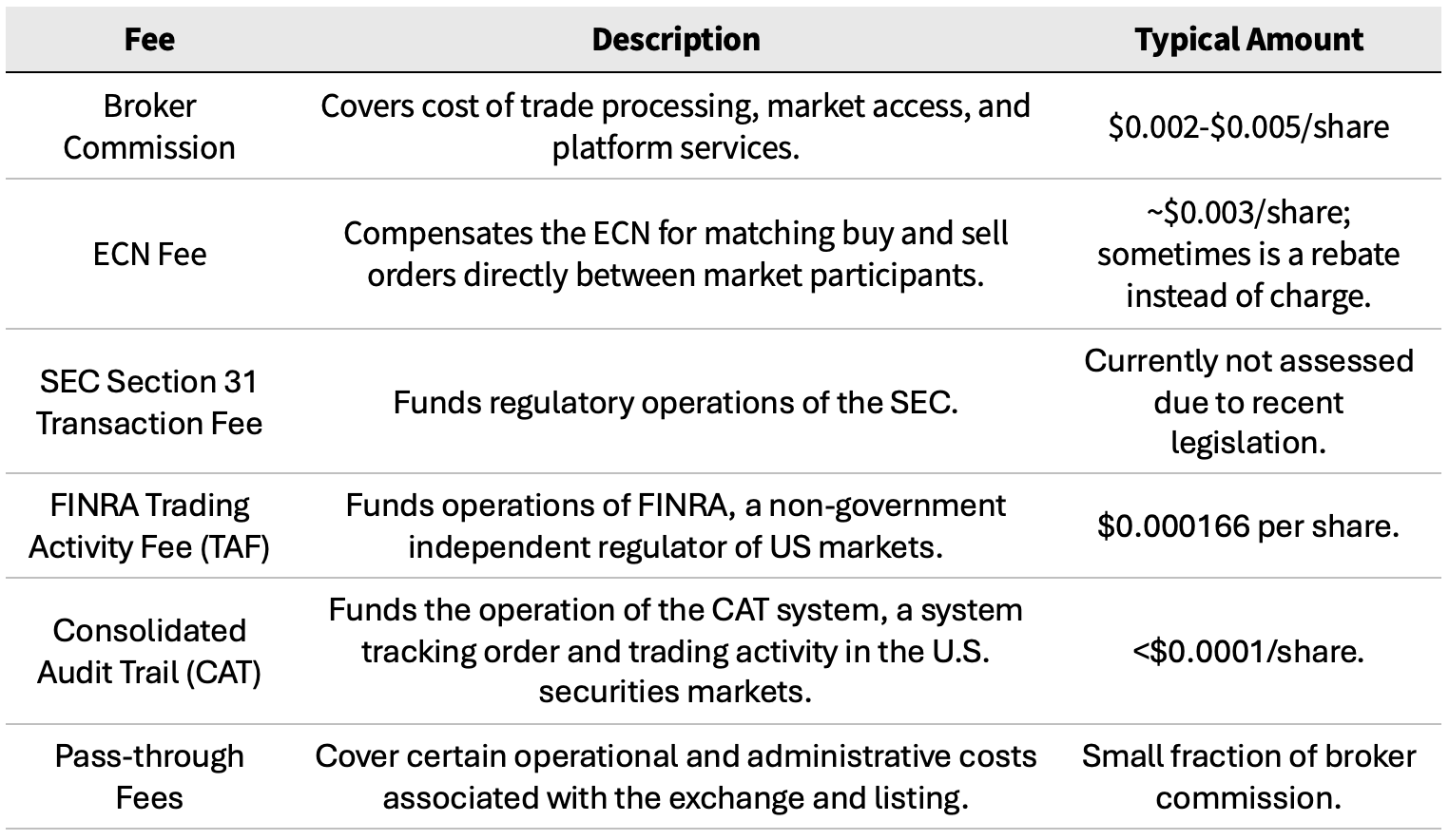
Table 4.2. Broker commissions and transaction fees.
Table 4.2 summarizes the broker commissions and transaction fees your trades will be subject to. You may encounter a few more on your brokerage statements, but they will be small and will not significantly affect your profitability. These fees and rates change frequently – be sure to check your broker’s fee schedule and statements for the most accurate information.
Broker Commissions
As of spring 2026, the two brokerages in Table 4.3 offer “per-share” commission structures (e.g., $0.005/share).
Within the per-share commission structure, there are “tiered” and “fixed.” With “tiered,” the commission rate decreases as you hit higher volume tiers during the month. Most beginner day traders fall into the lowest-volume tier. Penny stock traders (cheap stocks and therefore large share sizes) and traders with larger accounts may reach the higher-volume tiers.
IB also has a “fixed” commission plan. “Fixed” means there are no volume tiers and the rate is independent of volume. The per-share fixed rate at IB is $0.005, which also includes ECN and pass-through fees.

Table 4.3. Commission pricing options at CenterPoint and Interactive Brokers.
ECN Fee
ECN fees vary from broker to broker, depending on their business models and ECN agreements. The fee is usually about $0.0025/share, but it also depends on factors such as the route/ECN your trade goes through and whether you add or remove liquidity from the market. You may notice the ECN fee varies significantly when reviewing your brokerage statements. In some cases, you can even receive a rebate rather than being charged.
Of all the fees associated with trading, this is the only one that is not pre-determined. You know exactly how much the broker commission and other transaction fees will be before you submit a trade, but not the ECN fee, since you don’t always have control over how the order gets routed. However, the average ECN fee should be roughly $0.0025/share on average over all your trades, so you can use that value when estimating total transaction fees.
For IBKR Pro Per-share (Fixed), ECN fees are included in the $0.005/share commission rate.
Regulatory, Clearing, and Pass-through Fees
Entities such as National Securities Clearing Corporation (NSCC), SEC, and FINRA also have their hands in your pocket on every trade. Fortunately, these fees are only fractions of a penny per share and do not significantly impact your profitability as a day trader. These fees vary year to year as legislation changes, so brokerage websites and your statements are the best source of up-to-date information.
Price Action Needed to Cover Commissions & Fees
Roughly speaking, commissions and fees amount to about $0.005 per share. This is a good value to use when estimating commissions and fees. So if you buy 1000 shares and sell 1000 shares, the total commissions and fees will be 2000 * $0.005 = $10.
Since the round-trip total is $0.01/share, that means, in order to reach breakeven, you need the stock price to improve an additional $0.01 beyond the bid-ask spread to cover commissions and fees.
However, in some cases, you can actually get paid by the broker for making the trade. If you receive a rebate for the ECN fee, it can actually exceed commissions and other fees in some cases. You can essentially get paid for providing liquidity to the market. This depends on several factors, which are posted on the broker’s website.
You may visit the book’s website for more up-to-date information on broker commissions and fees. The website also has links to example trade commissions and fee breakdowns at IB and CP.
Recommendation
IBKR Pro Fixed is the account type I use and what I believe is the best choice for most new day traders.