
In Chapter 2, we briefly discussed research studies analyzing day traders’ performance. One of the best studies to date was conducted by a group of American and Chinese university researchers in 2014, using Taiwan Stock Exchange data. It’s a significant study because they were given rare access to an exchange’s complete transaction history for 15 years.
The researchers analyzed all transactions from 1992 to 2006 and examined performance variation across all traders. They found that “less than 1% of the day trader population is able to predictably and reliably earn positive abnormal returns net of fees.” Ouch!
So why is everyone so bad at trading? There are several reasons, but I believe the most significant is the lack of rigorous risk management.
This is the practical risk-management problem that binomial process trading is designed to control. If the win amount, loss amount, exit prices, and position size change from trade to trade, the trader is not running a clean process. The RST Way uses fixed risk, fixed reward, predefined exits, and automated share sizing to make those risks measurable before the trade is entered.
Alan Greenspan, Chair of the U.S. Federal Reserve from 1987 to 2006, said, “Risk management may be the only truly necessary element of success.” To newcomers, the world of day trading appears to revolve around candlestick patterns and indicators, but in reality, it’s about risk management.
Most traders preach the importance of risk management, yet their own trading is quite lacking. Some of their rules of thumb are “cut losses and let runners run,” “decrease share size for volatile stocks,” and “don’t risk more than 2% of your account on any trade.” This is not bad advice, but it is not remotely enough to get you into the top 1% (the consistently profitable traders).
That small number of consistently profitable traders–do you think they just wing it and hope for the best, or do you think they have insanely rigorous risk management?
Day Trading Risks
Below are the primary risks traders face and why we practice risk management. In the next chapter, we will define risk management rules and procedures, which I call “The RST Way,” to address these risks.
- Gambler’s Ruin
- The Drawdown Effect
- Black Swan events and ‘mini catastrophes’
- Recency bias
- Over-complication
- Transaction risks
- Improper share sizing
- Losing money despite high win rate
- Psychological struggle with exiting positions
Gambler’s Ruin
Gambler’s Ruin refers to the fact that all traders with limited capital will eventually lose to those with unlimited capital (the market). This essentially says that all traders will eventually hit a losing streak so severe that they will go bankrupt while the market, of course, keeps going.
This eventually happens because there is a non-zero chance of a 1000-trade (or more) losing streak, even if you have a 99% win rate. The likelihood of this particular scenario is so low that it will never happen in a billion years, but the bad luck doesn’t need to happen all at once. It might start with a few bad trades here and there, but ultimately, a prolonged period of unprofitability can lead to the trader’s bankruptcy.
The Drawdown Effect
After a losing streak, the trader will suffer from something called “the drawdown effect,” or “loss-recovery imbalance problem.” The worse the losing streak, the greater the drawdown effect. If the drawdown is 50%, a 100% return is required to reach breakeven. And for a 90% loss, a 900% return is needed on the remaining balance.
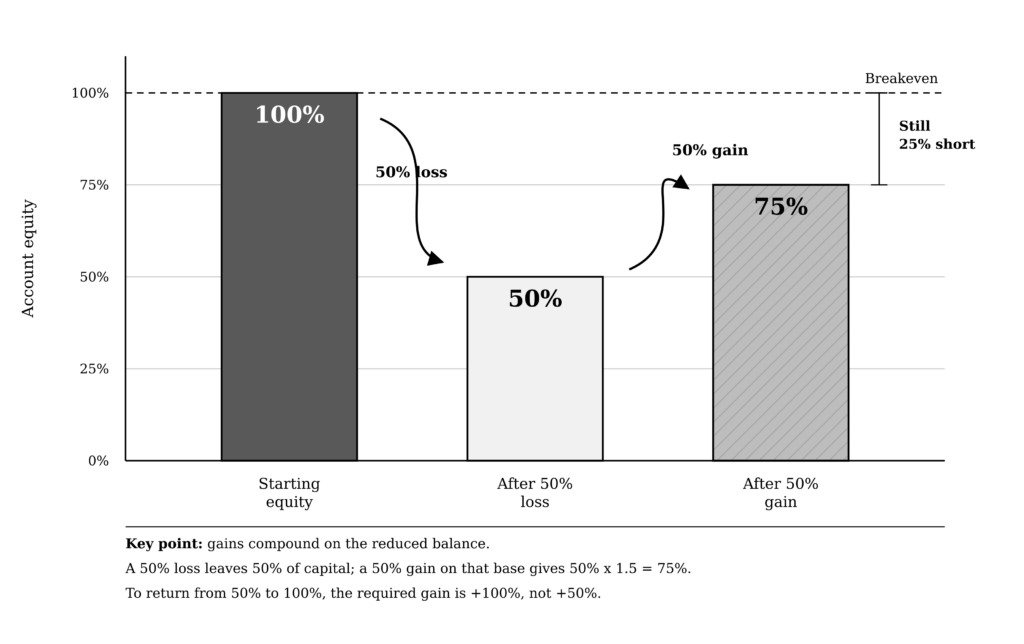
Figure 7.1. Drawdown Effect / Loss-Recovery Imbalance Problem.
The Drawdown Effect is worse for traders with more extreme R/R ratios, such as 1/3 or 1/4. These traders have higher losing percentages, so losing streaks are expected to be longer and more frequent. These traders must be very careful and trade with a smaller risk size compared to traders with an R/R ratio closer to 1/1.
The combination of Gambler’s Ruin and the drawdown effect is what consumes 99% of day traders. It’s a trap that is very easy to fall into when you are not trading with strict controls over share size and win/loss amounts. It’s basically a mathematical certainty. But if you properly control your share size, you can substantially reduce the risk of Gambler’s Ruin.
Black Swan Events
Another thing that can wipe out traders is a Black Swan event. These are rare but powerful events, such as the Great Depression, the dot-com bubble, the housing market crash, and COVID-19.
In general, day traders are not susceptible to Black Swan events since they are in and out of positions on very short time scales with intraday trading. Their capital is not sitting for days/weeks/months in stocks that are tanking due to the Black Swan event.
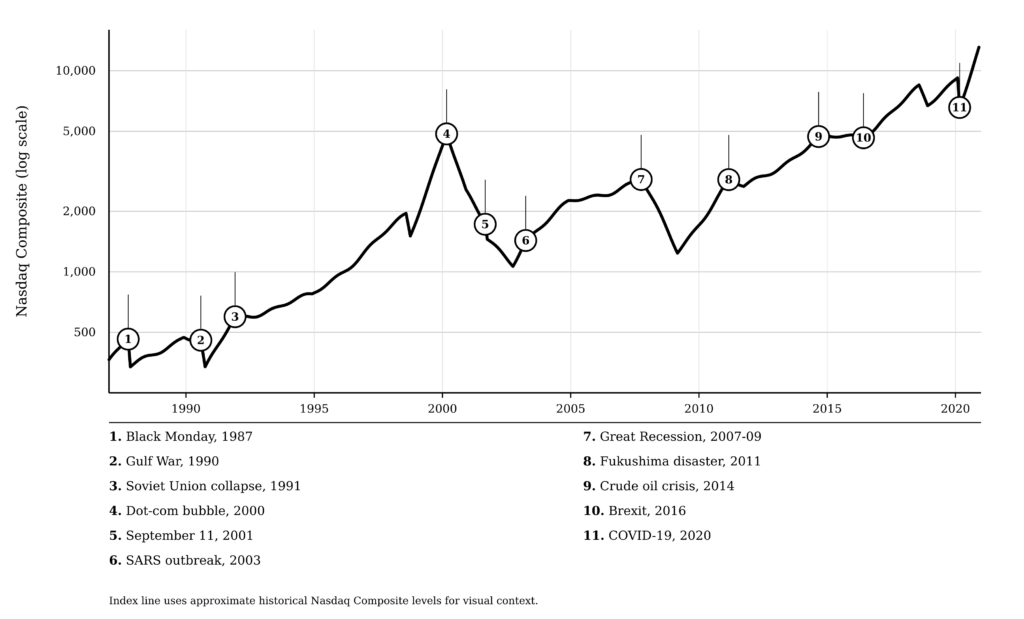
Figure 7.2. Black Swan Events.
However, some day traders may also engage in swing trading or long-term investing, which are susceptible to Black Swan events. And day traders are susceptible to what I call “mini Black Swan events” or “mini catastrophes”. These are the losses that get out of hand and wipe out days or weeks of gains—or worse, the trader’s entire account.
Regardless of the time scale and type of event causing the large loss, The RST Way protects traders’ accounts with hard stop losses that always exit the trader for a predetermined loss amount. RST traders do not experience large losses, as all losses are predetermined; the automated share sizing enforces this on every trade.
Recency Bias
There are thousands of day traders journaling their trades online, and you can see them overreacting to every losing trade. It would be like Steph Curry tinkering with his shot every time he missed one. That is insanity. It’s not only impractical, but it could also be very detrimental to his success as a shooter. What if the change in technique actually made him worse?
The same is true for trading. Winning every trade is not important. It’s about maintaining the necessary win rate to be profitable over a large sample of trades. Losing streaks are a mathematical certainty, and you should accept them for what they are. They are bad luck, not necessarily bad trading. Being able to tell the difference is critical to your success as a day trader, and we’ll discuss it in detail later in the book.
To address recency bias, RST traders always trade in blocks of at least 100 trades and only make changes to the system at those intervals.
At those intervals, RST traders employ a straightforward method of diagnosing and improving their trading, made possible by its extreme simplicity. Other traders do not have this luxury, and it’s a huge risk trading the way they do- systems full of complex entry and exit strategies, pages of rules for entry and exit, and so on. With so many convoluted variables at play, it’s impossible to disentangle everything and identify exactly what needs to change to improve profitability. But with The RST Way, it’s dead simple.
Over-Complication
Most new traders tend to think “just one more indicator” is the answer to all their problems. Eventually, their charts look like Jackson Pollock paintings.

Figure 7.3. “Convergence” by Jackson Pollock.
However, this type of trading is impossible to diagnose and improve, making it doomed to fail. When it comes to trading, less is best. All rules and criteria for finding trades, entering positions, and exiting them should be as simple as possible.
Transaction Risks
There are several types of transaction risks. First, there is the risk of missing a promising trade because your capital is tied up in other trades. You can address this by limiting the amount of capital per trade, but this might hurt your account growth more than it helps. If you limit the buying power per trade, your share size and profits will be correspondingly smaller. In general, when trading The RST Way, your buying power per trade is usually small enough to allow 2-3 simultaneous trades at any given time.
The other type of transaction risk concerns the amount of capital you may be using on each trade. Personally, I’m comfortable using 100% of my capital on a single trade. It feels unnatural at first since you’ve just shoved your entire account in the market, but the likelihood of a computer glitch that makes your money disappear is acceptably low in my opinion. But if it’s something you are not comfortable with, there are ways to properly limit the capital per trade, which we’ll discuss later in the book.
Improper Share Sizing
Another frustrating risk, especially for new traders, is letting share size dictate your trading. This may sound strange, but it happens to all traders without strict share-size controls, especially to new traders who are not used to trading volatile stocks. Most new traders use a fixed share size, such as 100 or 200 shares per trade, and often get stopped out immediately after entering. This is because it is common to also use a max loss per trade, and that amount can be realized very quickly with volatile stocks. The share size was too big in this case, and the candlestick pattern never got a chance to play out. Despite reading the chart perfectly, the trade still lost due to improper share sizing.
Losing Money Despite High Win Rate
You can have a 90% win rate and still lose money if the average size of losses dramatically outsize the average size of your wins. It all depends on risk/reward ratio and win rate, which we’ll discuss in depth in the next chapter. If you don’t control your risk/reward ratio, a few bad losses can swing profitable trading into unprofitable territory despite an overall high win rate. This goes back to the ‘mini-catastrophies’ mentioned earlier. However, if you strictly control your risk/reward ratio using predetermined exit prices (as we do under The RST Way), you can mitigate this risk.
Psychological Struggle with Exiting Positions
Finally, there are significant psychological risks associated with trading that RST traders are immune to. Most traders have to sit and watch candlestick charts like a hawk after entering, agonizing over when to exit and whether to do it all at once or gradually. However, this is a non-issue for RST traders, as we automatically set the exit price based on our stop loss and R/R ratio, and we always exit with a single order for the full position. It’s truly “set it and forget it” trading. You can complete an entire trade in DAS Trader – the entry and exit – by pressing just one button.
Summary
There are clearly many risks that day traders need to manage appropriately to be profitable. To overcome these risks, you have two options: 1) persist year after year, blowing up several accounts before eventually learning to read the markets like Neo reads the matrix, or 2) impose rigorous risk management. In my estimation, only 1% of profitable traders learn to read the markets like Neo (that is, 1 in 10,000 day traders), while the other profitable traders are using rigorous risk management.
For the technical paper covering the expected-value model, assumptions, and failure modes, see Binomial Process Trading: Technical White Paper.