
In the old days, you had to make a phone call to your broker to submit an order to the stock exchange on your behalf. Before the advent of electronic trading over the internet, “day trading” had a very different meaning. It basically took a full 24 hours to make a trade. You would check the newspaper for yesterday’s closing prices, call your broker to trade on your behalf, and then wait until the next day’s paper came out to make your next move.
Market mechanics matter because binomial process trading depends on predefined entries, exits, and position sizing rather than improvising after the trade is open.
Today, you can still pick up the phone and call your broker to place orders for you, but they’ll charge a premium for doing so. Nowadays, they would much rather you place the order yourself on your computer or smartphone.
Traders today may not have the personal relationships they once had with their brokers, but they still rely on them for vital operational support. Brokers provide crucial clearing and settlement services, ensuring their clients’ trades are guaranteed. Without brokers, traders would have to check the credit of every trader they deal with.
Today, thanks to electronic communication networks (ECNs), real-time trading is the norm. With “direct access” brokers and trading platforms, traders can submit orders directly to the exchanges from their trading software, where they are matched and filled within seconds—often less than one. Behind the scenes, these exchanges operate as double-sided auctions, where buyers and sellers continuously compete to set prices. Understanding how these auctions work is key to grasping the mechanics of modern markets.
Buy, Sell, Short, and Cover
Table 3.1 summarizes the terminology used for entering and exiting trades.

Table 3.1. Terminology for entering and exiting long and short positions.
When anticipating the stock price to go up, you buy shares, which is known as entering a long position. To close a long position, you sell your shares back to the market.
When the stock price is expected to go down, you enter a short position. This involves borrowing shares from your broker, selling them, and then buying more shares at a later time to return to your broker. This is known as covering the short position (closing it).
Since you must borrow shares from your broker to enter a short position, you cannot short any stock you want. You are dependent on the inventory of shares for short that your broker maintains. This will vary day to day and throughout the day. There is also significant variation among brokers.
Although the technicalities of shorting stocks are more complicated than taking long positions, the actual process of executing either type of trade is essentially the same within your trading platform. The only difference is declaring whether you want to go long or short.
You may have heard that your losses on a short position are theoretically infinite, which is true, but there are some limitations. It’s true that there is no upper limit on stock price, so losses on a short position could go to infinity. But in reality, brokerages impose minimum account equity requirements and issue margin calls when necessary. Brokers aren’t going to allow you to lose all of your equity plus the margin they extended to you, thus putting their own capital at risk. So, whether it’s a long or short position, when your account equity gets too low, they will issue a margin call, which means you have to deposit more funds, or they will automatically close your position, and you take the loss.
However, you should never encounter this when trading The RST Way, as you would never risk more than ~1-2% of your account equity on any given trade.
Double-sided Auctions
Every stock has two prices: bids and asks, determined by a double-sided auction. This is shown in Figure 3.1 below, which is called the “montage” window in my preferred trading platform, DAS Trader.
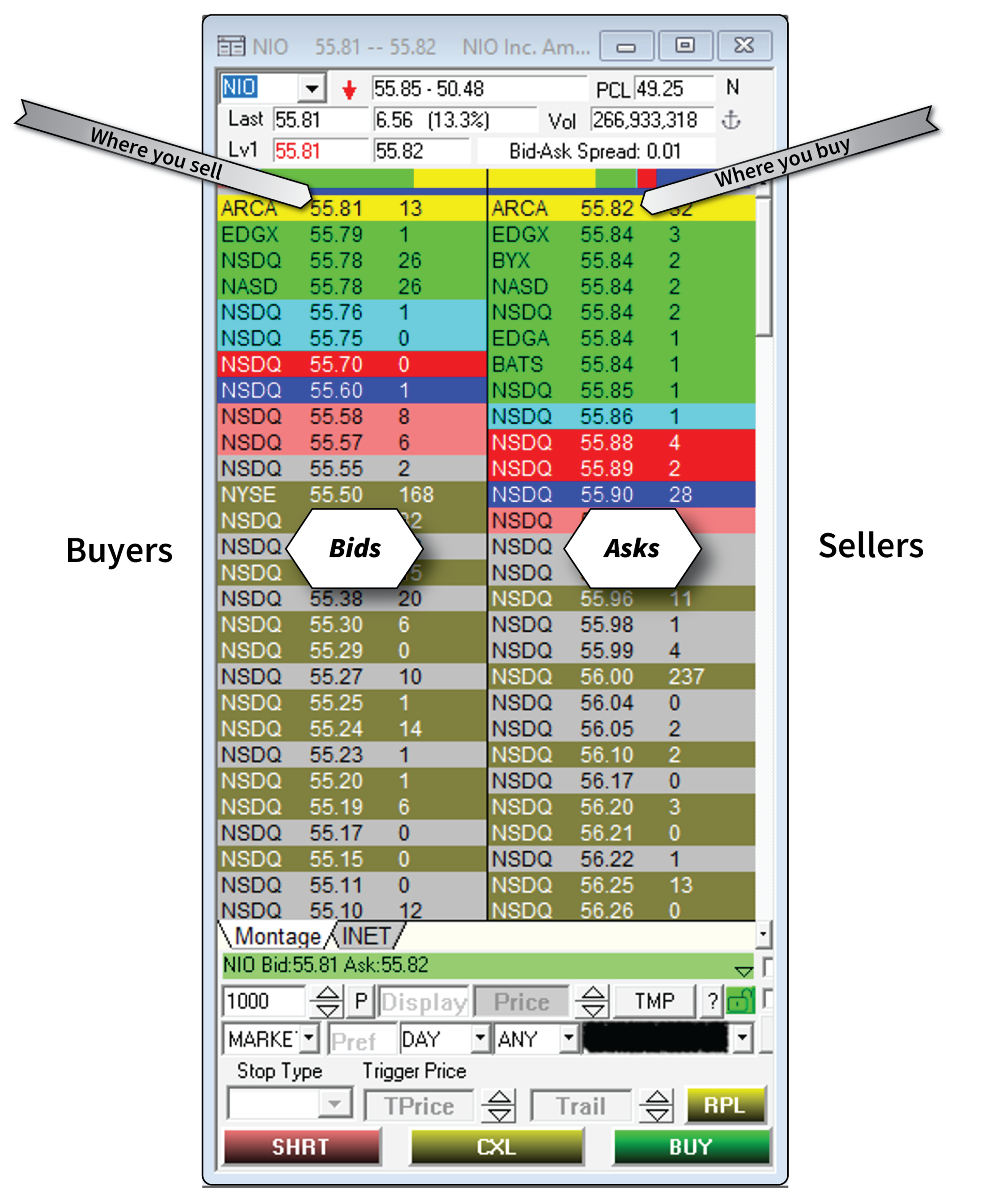
Figure 3.1. Montage window in DAS Trader with level 2 order book of buyer and seller orders.
“Bids” are orders submitted by traders looking to purchase shares at their own specified price (left side of Figure 3.1). “Asks” are the orders submitted by traders wanting to sell shares at their specified asking price (right side of Figure 3.1). This collection of open buy and sell orders (bids and asks) is known as the “level 2 order book.” These are all the unfilled orders looking for trading partners. The Level 2 order book shows the double auction in real time, with orders being added and removed on both sides of the book at a very rapid pace for volatile stocks. (“Level 1” is simply the best bid and ask. When setting up your trading platform and purchasing a data subscription, almost all day traders choose to include level 2 data for reasons we’ll discuss in Chapter 6.)
If you want to buy shares, you can either trade with an existing seller (right side of the order book) or join the list of buyers on the bids (left side of the order book) and wait for the stock price to reach your specified price.
When selling or shorting shares, you have similar options. You can either sell to the existing buyers on the left or add an order to the list of asks on the right, and hope the stock price moves to your asking price.
Per The RST Way, we always trade with existing buyers/sellers and do not add our own orders to the book.
The difference between the best bid and ask prices is known as the “bid-ask spread,” which varies by stock, time of day, and other factors. If you were to buy shares and then sell immediately, you would suffer the cost of the bid-ask spread in addition to broker commissions and fees. If your order is for 1000 shares and the spread is $0.20, that is an additional $200 in losses on top of commissions and fees. For this reason, it’s essential to trade stocks with high volume and low bid-ask spreads.
You may have bought and sold stocks your entire life and had no idea you were participating in a two-sided auction like this, but this is how the stock market has always operated. Brokers like Charles Schwab and Fidelity want to make the experience as simple as possible, so they hide this process from you. However, to be a successful day trader, you must become completely comfortable with bids, asks, the order book, Time & Sales, and everything else in the trade platform.
Market, Limit, and Marketable Limit Orders
When you submit an order to the exchange, you must specify the order type: market or limit. There is also a third called “marketable limit,” which is really just a limit order in disguise.
Market orders are filled at the best bid/ask price on the order book. If there are not enough shares at the best price to fill your order, the rest of your order will be filled at the next best price, and so on. This is known as price slippage, and the larger your order, the more you can expect. That said, price slippage is not really an issue for small accounts under $100,000 when trading high-volume, high-float stocks.
The advantage of a market order is that it gets filled as quickly as possible. There is no control on price slippage, but you have peace of mind that your order will be fully executed. As explained further in Chapter 8, this is important for The RST Way of trading.
The second type of order is the limit order. Limit orders let you get better pricing on your trades than you can with a basic market order. With a limit order, you specify the price at which you want to trade. This means you have to wait for the market to move to your price before the order is filled. If the market does not move in that direction, your order will not get filled.
The control over price with a limit order is nice, but it comes with the risk that the order may be only partially filled or not filled at all. This is a considerable problem for day traders. If you’re in a position and use a limit order to exit, but the price never reaches your desired price, you will have to cancel the order and exit using a market order or another limit order with a price closer to the current best bid/ask price.
Marketable limit orders are a mix of both. They are essentially limit orders with really bad pricing. Instead of specifying a price better than the current best bid/ask price, as you would normally with a limit order, you would specify a price worse than the current best bid/ask price.
By doing this, your marketable limit order will start being filled immediately up to the price you set in your order. It’s similar to a market order because it begins to fill immediately, and it is like a limit order since it provides control over price slippage.
However, for RST traders, I recommend plain market orders. It’s more important to get the full share size filled than to achieve penny-perfect pricing, since partial fills will break the “fixed risk/reward ratio” and “fixed win/loss size” trading we require for The RST Way.
If, for some reason, your trading platform does not support market orders in certain situations (for example, DAS Trader range/bracket orders where one side is market but the other side is limit), you can use a limit order with very large allowable price slippage, which will effectively act like a market order and is how we execute trades under The RST Way.
Stop Orders
Before entering a trade, you should think about the price at which you will exit for a loss, which is known as the stop loss. Since your goal is to maximize profits and minimize losses, being able to exit a losing position quickly is critical. The worst thing you can do as a trader is sit around on a losing trade, waiting for it to turn around. As soon as the stock price demonstrates that the initial assumptions about its trend are false, you must exit the trade. Never hold it with hope of a turnaround. Remember, you don’t need to be right about every trade to be profitable. Depending on your risk/reward ratio, you can actually lose more than you win and still make a fortune.
There are two types of stop losses: mental stop losses and hard stop losses. A mental stop loss is used by someone who has a rough idea of where they will exit the trade for a loss, but they don’t want to fully commit to a specific price because the stock’s price action is more important to them. This means that while the position is open, the price could fluctuate wildly, but the trader has enough experience to distinguish actual trends from erratic/random behavior. This trader does not want to get stopped out of a trade prematurely by a transient down tick, so they instead will watch the price action like a hawk and exit the position when the trade goes bad.
This can work for the most experienced traders, but it has serious disadvantages for 99.99% of traders. The biggest disadvantage is that the price can move quickly, and large losses can accumulate within a few seconds. To avoid this, it is recommended that all new traders use hard stop loss orders to exit the position when the price moves to a predetermined value. Hard stop losses are required for The RST Way.
Setting the stop loss close to the price action will make your losses smaller, but it comes with a higher likelihood of getting stopped out, which may lower your win rate and profitability. Setting the stop loss far from the price action gives the trade more room to breathe and may yield a higher win rate, but it comes at the expense of larger losses.
Where to set the stop loss is a tricky balancing act to get used to at first, but over time, you will get the hang of it. We’ll discuss how to find the sweet spot for stop losses in Chapter 8.
Short Selling Restriction (SSR)
Short Selling Restriction (SSR) is another important thing to be aware of as a day trader. You will encounter this almost daily when trading volatile stocks, so you need to know what “SSR” means when you see it on your trading platform (see Figure 3.2).
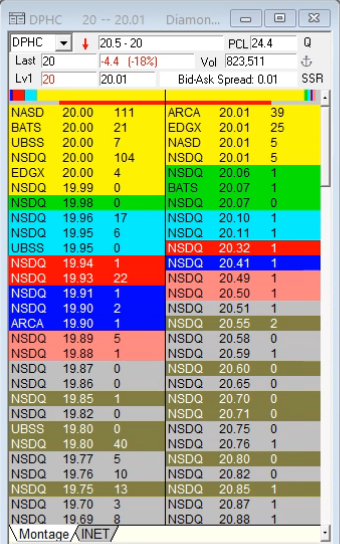
Figure 3.2. DAS Trader montage window for DPHC showing the stock is trading under Short Selling Restriction as indicated by the “SSR” text next to the bid-ask spread.
The SSR rule was imposed by the SEC in 2010 to prevent stocks from rapidly tanking. If at any point during the day a stock’s best bid price is 10% lower than the previous day’s close, the SSR rule applies and remains in effect for the rest of the trading day. It applies to all stocks listed on American exchanges. The SSR circuit breaker effectively prohibits the display or execution of a short sale order at the best bid or lower, even if the short sale order was a market order.
Therefore, under SSR, you are not allowed to take liquidity from the market by short selling on the bid. Preferential treatment is given to traders holding long positions. They can still sell their shares on the bid as usual, but short sellers must do so with a limit order above the best bid. In the case of DPHC in Figure 3.3, you would have to submit a limit order for at least $20.01 (technically, at least one “tick” above the best bid of $20.00). If the bid reaches that amount, your order is recognized by the exchange and will be filled along with the other sell orders.
For these reasons, you must have two hotkeys in DAS Trader for short selling: one to open a trade when the stock is under SSR and another when it is not. When there is no SSR, your hotkey will short sell on the bid as normal. Under SSR, you must submit a limit order of at least one tick (one cent for most stocks) above the best bid. This is why SSR is also known as “the uptick rule.” Your hotkey would include a command like “bid + 0.01″. Of course, there’s no guarantee that the order will be filled since there may not be enough supply to meet the demand of all the short sellers at that price. As you’ll see in Chapter 8, this generally means RST traders should not trade stocks under SSR, as the limit order may not be completely filled, and the trade will not fit the RST risk management plan.
Market Hours & Volume
The New York Stock Exchange (NYSE) and National Association of Securities Dealers Automated Quotations (NASDAQ), the two primary stock exchanges in the United States, are open for trading from 4 a.m. to 8 p.m. EST. “Pre-market” is 4 a.m. to 9:30 a.m., “regular trading hours” are 9:30 am to 4 p.m., and “after-hours” is 4 a.m. to 8 p.m. No trading occurs overnight from 8 p.m. to 4 a.m. Most trade volume occurs during regular hours, with <5% occurring in pre-market and after-hours sessions.
All three periods from 4 a.m. to 8 p.m. are available for trading, but since liquidity and volatility are paramount to day traders, you’ll mostly be trading during normal trading hours from 9:30 a.m. to 4:40 p.m.
Figure 3.3 shows trading volume throughout the day. The bars at the bottom of the chart represent trade share volume for each 30-minute period during the day from 4 a.m. to 8 p.m. for AMD on 7/9/21. The volume during pre-market and after-hours trading barely registers on the chart, with the highest volume occurring in the first half hour of our day, after regular trading begins at 9:30. This is when most day traders try to make their money.
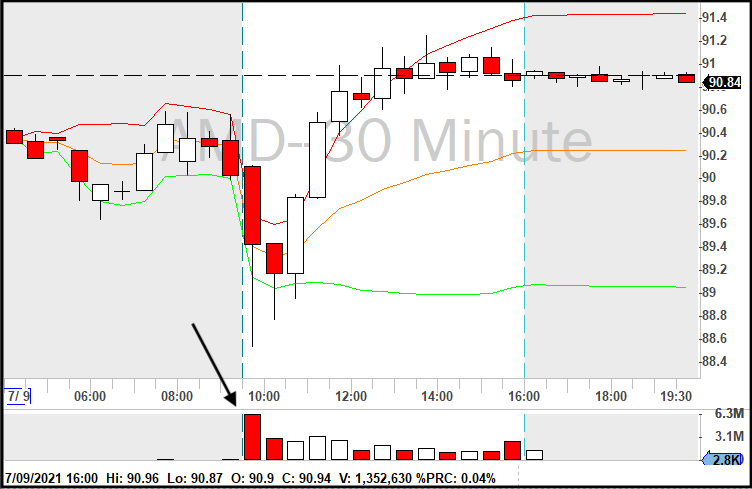
Figure 3.3. 30-minute chart for AMD on 7/9/21 showing price candlesticks (top) and share volume (bottom). The highest volume during the day is found during the first half-hour after market open.
Figure 3.4 below is a zoomed-in view of the first hour, further illustrating how the market explodes with volume and volatility at market open, with the first 1-minute candle having the largest volume on the chart. All of the trading demand that is built up overnight is released at this point rather than during pre-market hours. Some strategic trading occurs during the pre-market, but 99% of the time, traders prefer the liquidity available only after the market opens.
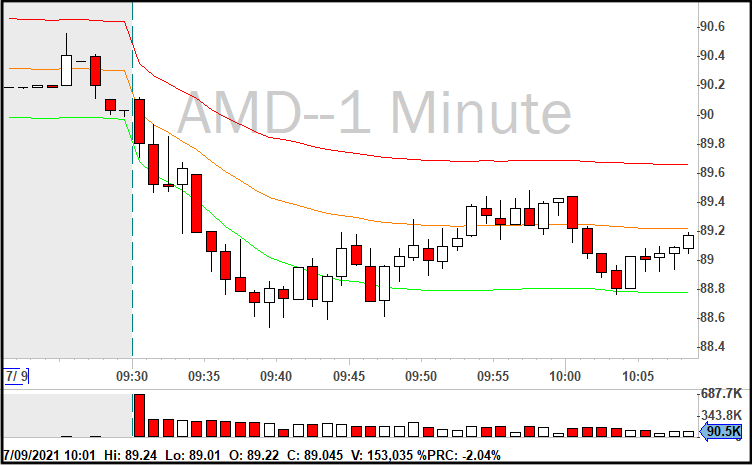
Figure 3.4. 1-minute chart for AMD on 7/9/21 showing volume per minute. The highest volume is found in the first minute after market open.