
The NASA Jet Propulsion Laboratory in Pasadena, California, is responsible for many of NASA’s flagship missions, including Mars rovers, outer planet explorers, and deep-space telescopes. I’ve worked there for over twenty years as a spacecraft electronics reliability engineer and have found these missions to be very challenging and rewarding.
This book introduces binomial process trading, the fixed-risk framework behind The RST Way. The concept page provides the concise definition; the chapters that follow explain how the method is applied in practice.
NASA often spends billions of dollars developing its one-of-a-kind spacecraft, so the expectation is that each one will complete its mission. To ensure that happens, NASA tests, models, and analyzes every aspect of the spacecraft’s systems using state-of-the-art technology and analytical techniques.
The data and process modeling skills involved in developing these priceless spacecraft translate to many other disciplines, including Wall Street. This is why hedge funds famously gobble up mathematicians, physicists, and engineers to help develop their trading systems. For example, Renaissance Technologies, the most successful hedge fund in history, is famous for hiring academics rather than traders. According to their founder, Jim Simmons, a brilliant mathematician himself, “We hire physicists, mathematicians, astronomers, and computer scientists, and they typically know nothing about finance.”
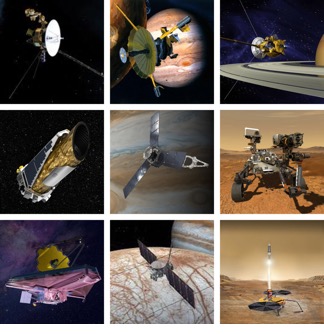
Sample of NASA JPL missions and instruments by launch year: Voyager (1977), Galileo (1989), Cassini (1997), Kepler (2009), Juno (2011), Mars 2020 Perseverance Rover (2019), MIRI on James Webb Space Telescope (2022), Europa Clipper (2024), Mars Sample Return (TBD).
Relying on engineers’ technical analysis, rather than a deep understanding of market fundamentals, Renaissance’s Medallion Fund has never had a losing year, except the fund’s first year, which was negative after subtracting management fees. From its inception in 1988 to 2018, it averaged 66% annual returns before fees and 39% after fees, making it the most successful hedge fund in history —powered by a group of pocket-protector-wearing engineers and scientists.
Whether you are building robotic spacecraft to explore outer space or a quantitative hedge fund to dominate Wall Street, success depends on gathering data, developing models, and using those models to guide you.
In this book, I describe how to transform trading into a binomial process, which allows traders to model and manage their trading in ways not possible with traditional approaches to trading and risk management. This dramatically reduces the impact of a variety of risks on traders, maximizing the likelihood of becoming profitable. This is accomplished using statistics and probability theory I learned on the job at NASA, along with share size automation available in the trading software. I call this risk management approach “The RST[1] Way.” Despite being born out of the same mathematics used by rocket scientists and hedge funds, it’s actually the simplest form of trading I can imagine. I call it “one-button trading” because you only have to hit one button to complete a trade, which includes the entry as well as the exit. The simplicity of the trading process, as well as its built-in method for improvement, makes this trading system perfect for new traders. It’s also great for traders of any experience level who are looking for safer, more controlled trading. If having wins of $500 and $1000 followed by a loss of $2000 is driving you crazy, then The RST Way of trading is for you!
[1]“RST” is short for “Rocket Science Trading,” our community of traders using The RST Way.